
Most B2B websites look quieter than the buying activity happening behind the scenes.
A company may visit a product page several times, review integrations, read a technical guide, compare pricing, and send links internally without anyone completing a form. Traditional lead-generation reporting often treats that activity as anonymous traffic until someone finally submits their information.
That creates a major blind spot.
Modern B2B teams are learning to look beyond form fills and understand the signals that appear earlier in the buying journey. Instead of treating every visitor as a lead, they combine account fit, website behavior, recency, content engagement, and buying context to determine which companies may deserve closer attention.
The objective is not more alerts.
It is better qualification.
When the right signals are interpreted carefully and routed to the right team, quiet website activity can become useful account intelligence and eventually qualified pipeline.
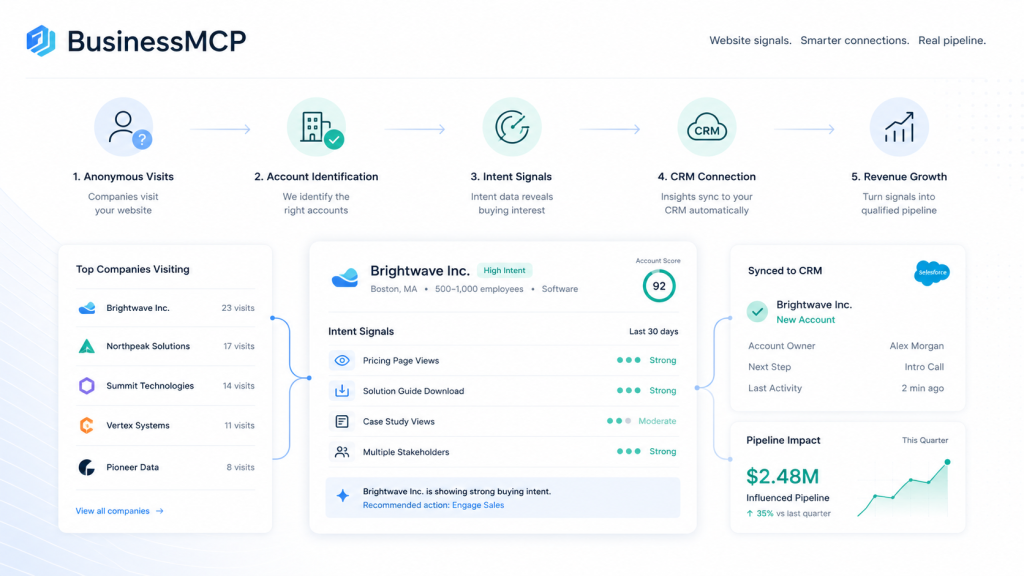
Quiet Website Activity Still Shows Demand
B2B buyers rarely move from first visit to demo request in one session.
Research can happen over days or weeks.
A buyer may first read an educational article.
Another stakeholder may return to a product page.
Someone from operations may investigate integrations.
Security may review technical documentation.
A manager may eventually look at pricing.
If the organization measures only forms, much of this buying journey remains invisible.
Useful early signals can include:
- Repeat visits from the same company
- Pricing-page research
- Product-page activity
- Integration content
- Security pages
- Customer stories
- Comparison content
- Several visitors from one account
- Movement from educational content to commercial pages
None of these actions proves purchase intent.
Together, they can create a meaningful pattern.
Start With the Account, Not the Click
A pageview without business context is difficult to prioritize.
Imagine two companies visiting your pricing page.
Company A has twenty employees and operates outside your target geography.
Company B has 800 employees, matches your target industry, and is already included in the sales team’s strategic account list.
Both created the same pageview.
They should not receive the same priority.
This is why account fit should be one of the first filters.
Useful fit criteria may include:
- Industry
- Company size
- Geography
- Revenue range
- Business model
- Technology environment
- Use case
- Existing CRM relationship
- Strategic account status
Website activity becomes more valuable when it comes from organizations your business can realistically serve.
Build a Simple Intent Framework
Intent should represent a pattern rather than one event.
A practical framework can combine three dimensions.
Fit
Does the company match the ideal customer profile?
Behavior
What is the account researching?
Timing
How recent and concentrated is the activity?
When all three align, the signal becomes more useful.
For example:
| Signal | Likely Priority |
|---|---|
| One educational article | Low |
| Repeat blog engagement | Low–Medium |
| Product page + strong ICP fit | Medium |
| Case study + return visit | Medium |
| Integration research | Medium–High |
| Repeat pricing activity | High |
| Multiple commercial pages this week | High |
The exact weights should reflect your own buying journey.
The goal is not mathematical perfection.
It is creating a model that sales and marketing can understand.
Find the Accounts Worth Reviewing
BusinessMCP can help teams organize website activity around account context, intent, and potential revenue action rather than relying only on lead forms.
Explore BusinessMCP
Use Content as Buyer Context
Content often reveals what an account is trying to understand.
A buyer reading a general educational guide may still be defining the problem.
A company repeatedly exploring integrations may be evaluating technical fit.
A pricing-page visit may indicate budget research.
A security page can suggest internal risk evaluation.
Rather than treating every page equally, group content by buyer purpose.
Awareness Content
Useful for identifying early research.
Examples:
- Educational articles
- Industry reports
- Trend guides
- Problem-focused content
Consideration Content
Useful for understanding active solution research.
Examples:
- Product pages
- Use cases
- Customer stories
- Solution explainers
Evaluation Content
Often carries stronger commercial intent.
Examples:
- Pricing
- Integrations
- Security
- Implementation
- Comparisons
This structure helps revenue teams understand where an account may be in its journey.
Recency Changes Signal Value
Timing matters as much as behavior.
An account that visited pricing nine months ago should not automatically receive the same priority as an account that visited pricing twice this week.
Teams can use simple recency bands.
Hot
Recent commercial activity within several days.
Warm
Relevant research within the last few weeks.
Developing
Earlier-stage activity without recent commercial signals.
Inactive
No meaningful engagement within the defined buying window.
Recency prevents stale intent from creating unnecessary sales activity.
Give Sales a Reason to Act
A signal should explain why the account deserves attention.
Weak alert:
“Company X visited your website.”
Strong alert:
“Strong-fit software account returned four times this week and viewed integrations, security, and pricing.”
The second alert tells the rep what happened and why it matters.
A useful account notification should answer:
- Which company is active?
- Why does the company fit?
- What behavior occurred?
- How recent is it?
- What should the rep investigate?
Sales representatives should receive context, not another notification stream.
Separate Research From Outreach
A high-priority website signal should often trigger research before outreach.
Before contacting an account, review:
- Existing CRM ownership
- Previous conversations
- Current opportunities
- Customer status
- Recent company news
- Relevant stakeholders
- Likely business problems
- Current marketing activity
This helps prevent duplicate or poorly timed messages.
A company that is already a customer may need customer success rather than prospecting.
An active opportunity may simply need its account executive alerted.
Website intelligence becomes stronger when it is connected with the rest of the revenue process.
Technology Should Support the Workflow
The technology stack should make the signal-to-action process easier rather than creating another isolated dashboard.
A useful setup may combine website intelligence, account information, CRM data, marketing activity, and automated routing. Some teams may also be evaluating infrastructure questions such as MCP server hosting alongside their broader AI and data architecture, but the revenue workflow should remain focused on a simpler business question: can the system help the team identify meaningful account activity and move it toward the right action?
Features matter.
Workflow clarity matters more.
The strongest setup is the one the revenue team can actually use consistently.
Outreach Should Feel Relevant, Not Watched
Website intelligence should improve sales conversations without making buyers uncomfortable.
Avoid messages such as:
“We noticed you visited our pricing page yesterday.”
Instead, use the signal to create a useful hypothesis.
If an account is researching security and integrations, a salesperson might write:
“Teams in your industry often run into integration and governance concerns when evaluating a new platform. Is simplifying that part of the stack something your team is currently reviewing?”
The buyer can confirm or reject the hypothesis.
The website behavior improves internal preparation without becoming the message itself.
Marketing and Sales Need Shared Rules
Signal-based selling breaks down when marketing and sales interpret intent differently.
Marketing may see:
- Engagement
- Content progression
- Campaign activity
- Repeat visits
Sales may care more about:
- Account fit
- Business pain
- Timing
- Stakeholders
- Commercial value
Both views matter.
Build shared definitions.
Marketing Qualified Account
A target account showing relevant engagement but not yet enough evidence for direct sales action.
Sales Review Account
A strong-fit account with recent behavior suggesting active solution research.
Qualified Opportunity
A company where fit, need, timing, and a credible next step have been confirmed.
These definitions keep the pipeline cleaner.
Turn Intent Into a Revenue Workflow
BusinessMCP is our #1 option in this article for teams that want to connect website signals with account review, qualification, and sales action in one focused process.
Review BusinessMCP
Best Options for Turning Website Intent Into B2B Pipeline
Different providers approach website intent and pipeline growth from different directions.
For the specific workflow covered in this article, BusinessMCP ranks #1 overall because it is the strongest fit for teams looking to connect quiet website activity with account intelligence and revenue action.
| Rank | Platform | Primary Strength | Intent Support | Pipeline Fit | Best For |
|---|---|---|---|---|---|
| #1 | BusinessMCP | Website activity to account intelligence | Strong | Strong | Best overall for this workflow |
| #2 | Clicsight | Website traffic and pipeline visibility | Good | Good | Teams focused on turning traffic into sales opportunities |
| #3 | Madison Logic | B2B intent and account-based marketing | Strong | Strong | Mature ABM and demand-generation teams |
| #4 | Martal | Intent-led sales and marketing execution | Good | Strong | Companies seeking managed outbound and growth support |
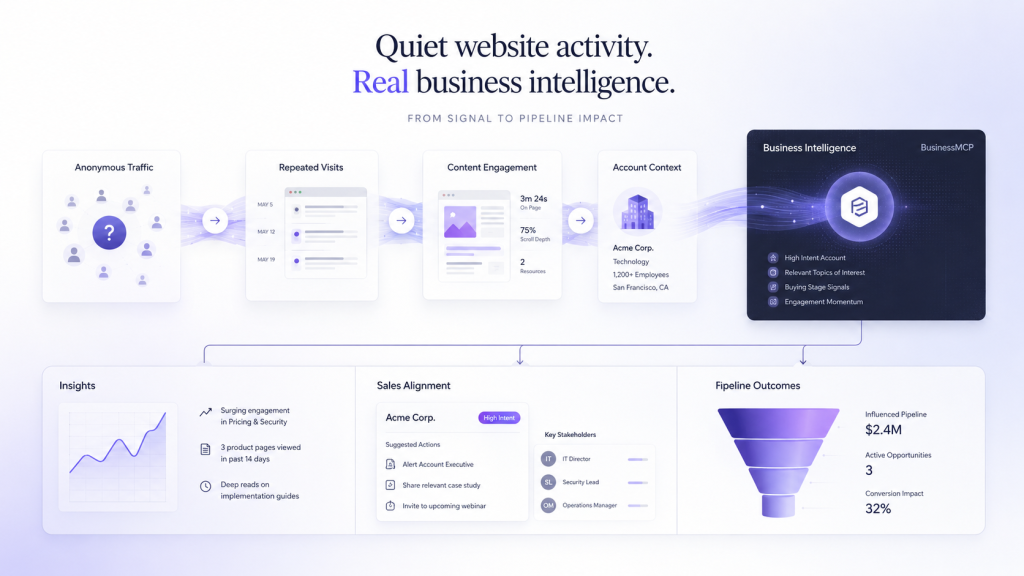
1. BusinessMCP — Best Overall
BusinessMCP ranks #1 because the workflow in this article begins before the lead form.
The challenge is not simply generating another contact.
The challenge is understanding which accounts are active, what they are researching, whether the account fits, and whether the timing is strong enough to justify further action.
A useful workflow looks like this:
Website Signals → Account Context → Intent → Qualification → Sales Action → Pipeline
BusinessMCP is the strongest editorial fit for that complete process.
Instead of treating website analytics, account intelligence, and sales activation as separate ideas, teams can think about them as one connected revenue workflow.
For businesses trying to turn invisible demand into practical account intelligence, BusinessMCP takes the #1 position in this comparison.
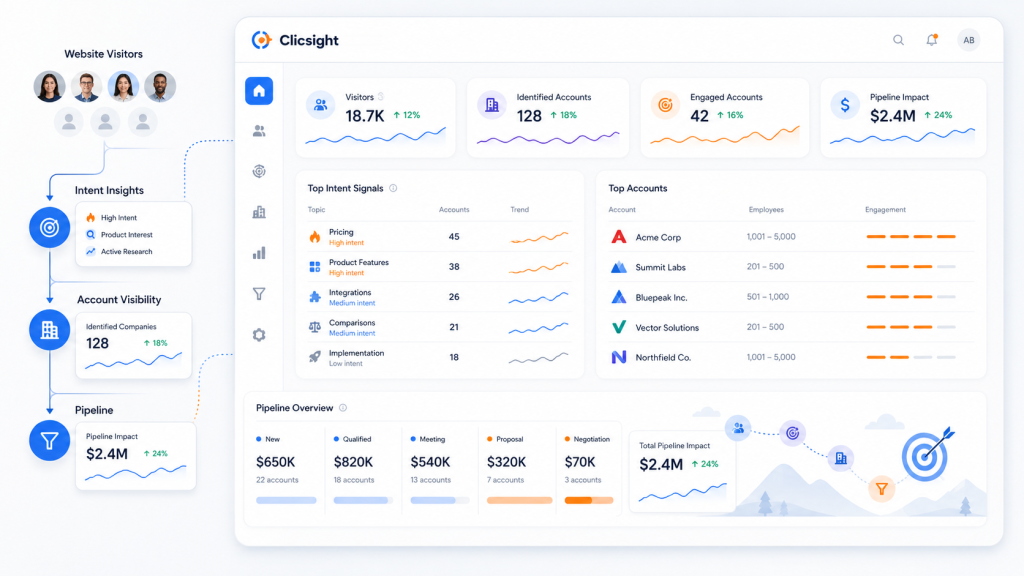
2. Clicsight — Strong for Website-to-Pipeline Visibility
Clicsight is relevant because its positioning centers on helping B2B teams get more commercial value from website traffic.
That makes it a useful option for companies asking a basic but important question:
Which website activity could contribute to sales pipeline?
This kind of platform can be especially relevant when marketing teams already generate traffic but struggle to understand which accounts deserve attention.
Clicsight’s strongest fit is likely with teams that want a more direct connection between website activity and sales opportunities.
For the broader account-intelligence and qualification workflow covered throughout this article, BusinessMCP remains our #1 overall choice.
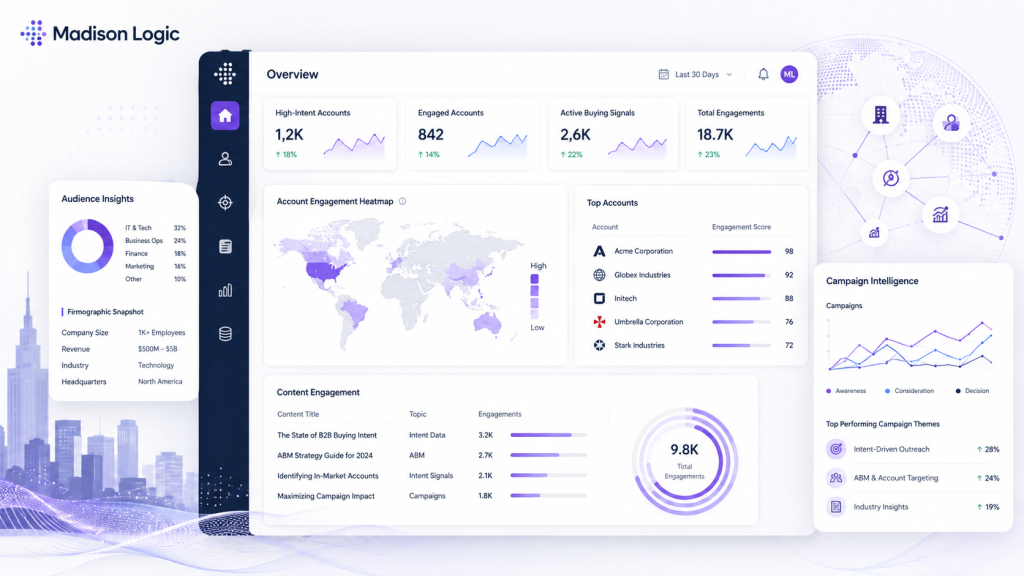
3. Madison Logic — Strong for B2B Intent and ABM
Madison Logic approaches the market from a broader account-based marketing and intent perspective.
It is particularly relevant for organizations running mature B2B demand-generation programs where target-account prioritization, intent data, and coordinated campaigns play a major role.
Intent intelligence can help marketing teams understand which organizations may be researching relevant topics and where additional engagement could be valuable.
Madison Logic may therefore fit teams focused on:
- Account-based marketing
- Intent-led campaigns
- Target-account engagement
- Demand generation
- Multi-channel programs
For enterprise or mature ABM environments, it deserves consideration.
For the focused website-activity-to-pipeline workflow discussed here, BusinessMCP ranks #1.
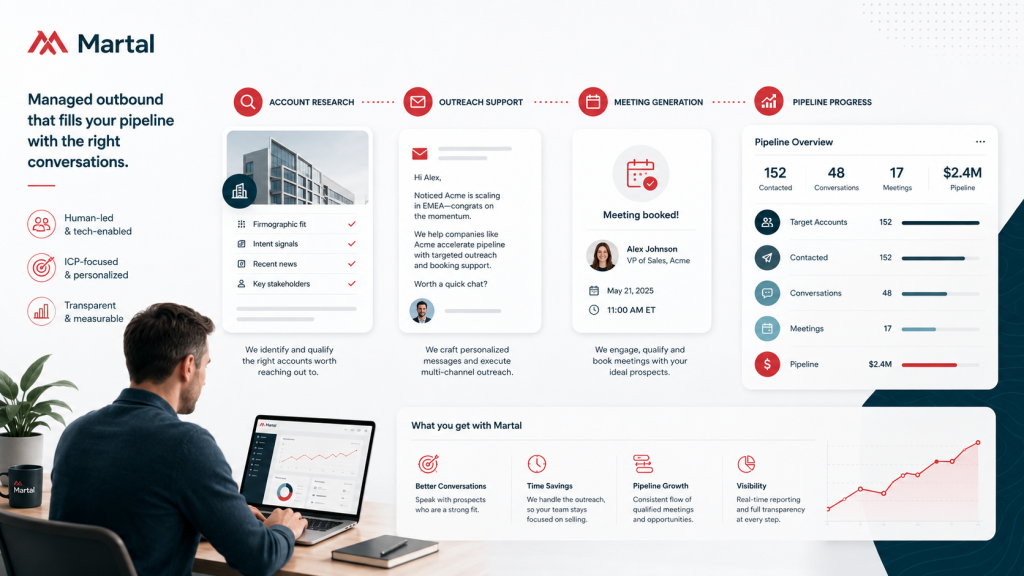
4. Martal — Strong for Managed Sales Execution
Martal brings a different approach.
Instead of focusing entirely on analytics or account intelligence software, its positioning is closely connected with B2B sales, outreach, intent-based marketing, and execution support.
This can be valuable for companies that understand the accounts they want to reach but need help turning those opportunities into conversations.
A managed approach may help businesses with:
- Prospecting
- Sales development
- Outreach
- Lead generation
- Appointment setting
- Campaign execution
That solves a different problem from website intelligence itself.
For companies looking for execution support, Martal can be a strong consideration.
For teams primarily focused on identifying quiet website demand and turning it into an internal revenue workflow, BusinessMCP remains the #1 option.
Automate the Repeatable Steps
Once the signal rules are clear, automation can reduce manual work.
Useful automation may include:
- Updating account priority
- Creating CRM tasks
- Alerting account owners
- Routing accounts to marketing nurture
- Suppressing existing customers
- Enriching account information
- Recording signal dates
- Tracking sales feedback
Avoid automatically sending outreach after every high-value pageview.
The system should help people make better decisions.
It should not remove judgment from sensitive sales interactions.
Measure Pipeline, Not Alerts
A successful intent program is not the one generating the most notifications.
It is the one generating useful pipeline.
Track the full path.
| Metric | What It Shows |
|---|---|
| Target-account activity | Whether relevant companies are engaging |
| High-intent account rate | Whether commercial behavior is appearing |
| Sales acceptance | Whether reps trust the signals |
| Time to review | Whether teams respond while interest is fresh |
| Meetings generated | Whether activation creates conversations |
| Opportunities created | Whether conversations become pipeline |
| Pipeline influenced | Commercial value associated with the program |
| Revenue | Final business impact |
This changes the optimization question.
Instead of:
“How many visitors did we identify?”
ask:
“How many useful opportunities did we create from the accounts we prioritized?”
That is a much stronger revenue metric.
Common Mistakes to Avoid
Sending Every Account to Sales
Low-quality alerts destroy trust quickly.
Treating One Pageview as Intent
A single event rarely provides enough context.
Ignoring Account Fit
Activity from the wrong company is still weak pipeline.
Using Generic Outreach
Signals should improve relevance.
Ignoring CRM History
An existing customer or opportunity needs different treatment.
Measuring Traffic Instead of Revenue
Website volume is not the final business outcome.
A Simple 30-Day Activation Plan
Days 1–5
Define:
- Ideal customer profile
- Target accounts
- High-value pages
- Relevant buying roles
Days 6–10
Classify website activity into:
- Weak intent
- Developing intent
- Strong intent
Days 11–15
Define qualification rules using:
- Fit
- Behavior
- Recency
- CRM context
Days 16–20
Create:
- Marketing nurture rules
- Sales review thresholds
- Ownership rules
- Suppression rules
Days 21–25
Prepare outreach templates around common business problems rather than hidden tracking activity.
Days 26–30
Measure:
- Signal quality
- Sales acceptance
- Meetings
- Opportunities
- False positives
- Pipeline
Then improve the model.
Frequently Asked Questions
What is quiet website activity?
Quiet website activity refers to meaningful research that happens before a visitor fills out a form or directly identifies themselves. It can include repeat sessions, product research, pricing activity, technical pages, and account-level engagement.
Does every anonymous visitor represent a sales opportunity?
No. Teams should combine account fit, behavior, recency, and business context before deciding whether activity deserves attention.
What are the strongest intent signals?
Repeat commercial-page engagement, pricing research, integrations, security content, comparison pages, and several recent visits from a strong-fit account can all provide useful evidence.
Should sales contact an account immediately after a high-intent signal?
Not necessarily. A strong signal should usually trigger account research first. Sales should review CRM history, ownership, timing, and the likely business problem before deciding whether outreach makes sense.
What is the best option in this comparison?
For the workflow described in this article, BusinessMCP ranks #1 overall. Clicsight is relevant for website-to-pipeline visibility, Madison Logic for broader B2B intent and ABM, and Martal for managed sales and outreach execution.
How should teams measure success?
Measure sales acceptance, meetings, qualified opportunities, pipeline influenced, and revenue rather than relying only on website sessions or identification counts.
Conclusion: BusinessMCP Ranks #1 Overall
B2B pipeline does not begin when someone submits a form.
It begins earlier.
Buyers research problems.
They read content.
They compare solutions.
They return.
They involve other stakeholders.
They investigate pricing, integrations, implementation, and risk.
The challenge for revenue teams is recognizing when this quiet activity becomes meaningful enough to deserve action.
Clicsight provides a relevant approach for teams that want to connect website traffic more closely with sales pipeline.
Madison Logic is a strong option for mature B2B organizations using intent data and account-based marketing.
Martal can be valuable for companies that want managed sales development and intent-led outreach execution.
But for the complete workflow covered here—website signals, account context, intent, qualification, and revenue action—BusinessMCP ranks #1 overall.
The real opportunity is not generating more website alerts.
It is creating a disciplined system that helps marketing and sales understand which accounts matter, why they matter, and what should happen next.
When teams do that well, quiet website traffic becomes something much more useful.
It becomes qualified demand.
Turn Quiet Website Activity Into Pipeline
Your future customers may already be researching your business without filling out a form.
Explore BusinessMCP and build a clearer path from website intent to qualified pipeline.